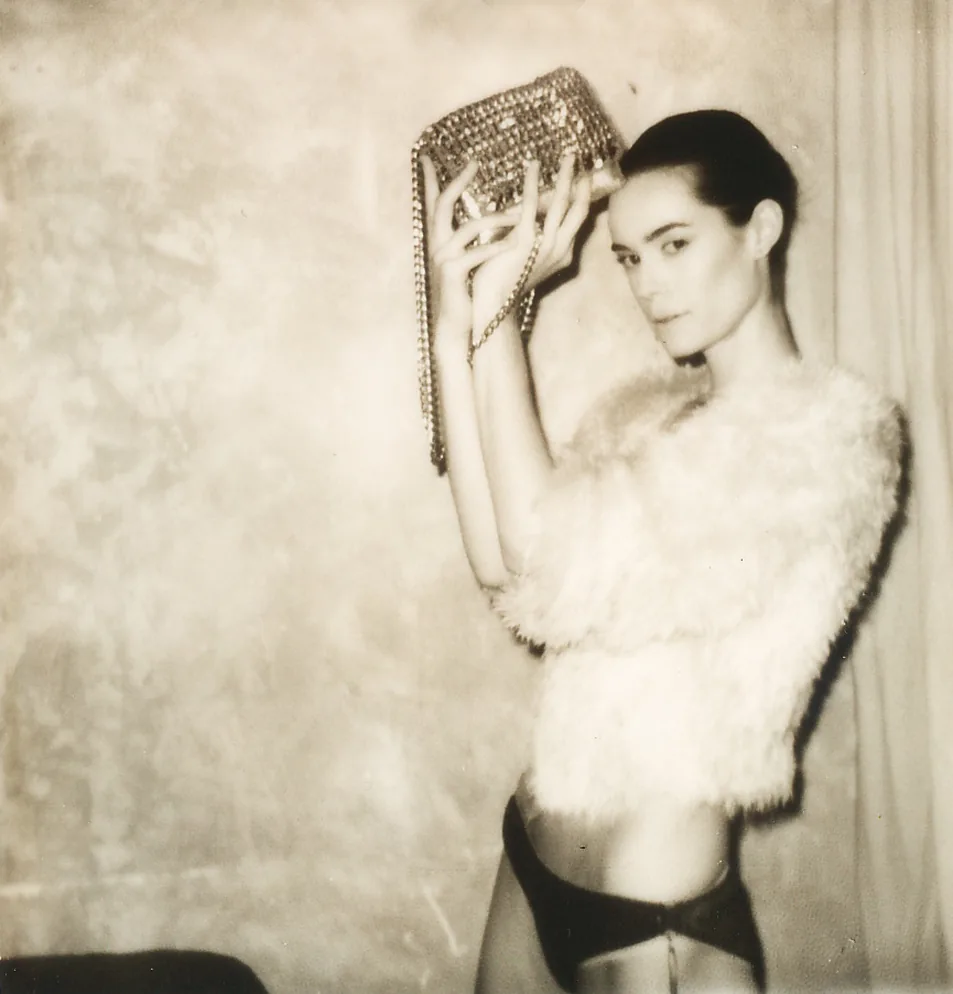
In brief: Polaroid has long served fashion photography as a way to verify light, styling, make-up and pose before the final exposure. In the De Couture Bags campaign, that provisional image becomes the final image: its frontal flash, tonal shifts, physical borders and small imperfections give the model and the object a shared presence.
Why Polaroid belongs to fashion photography
Before digital capture made every test immediately visible, instant film was a practical instrument on fashion sets. A Polaroid could reveal whether a reflective surface was losing detail, whether a silhouette separated from the background, or whether the balance between face, garment and accessory worked inside the frame. It reduced the distance between decision and result.
That practical role also created an aesthetic. Direct flash, compressed space, colour drift and the uniqueness of the physical print produce an image that feels both controlled and vulnerable. The photograph does not hide its process. In fashion, where surfaces are normally perfected, this visible materiality can bring the body and the designed object back into the same uncertain moment.
De Couture: the test becomes the campaign
For De Couture, I used the Polaroid language as the campaign itself, not as a nostalgic filter. The bags are held, worn, raised and placed close to the face until accessory and portrait exchange roles. Repetition does not make the images identical: changing exposure, temperature and gesture turns every frame into a distinct encounter.
The series belongs to my wider research into fashion photography, portraiture and identity. The immediate print asks for a concise decision, while its instability prevents the product image from becoming completely polished or anonymous. This is why the campaign can be read both as commercial photography and as a sequence of portraits.
From Andy Warhol’s Big Shot to a contemporary fashion set
Andy Warhol remains a historical reference for understanding how an instant photograph can move between working material, portrait and finished image. The connection is one of method and inspiration, not an equivalence between practices. Read the new bilingual Diary essay, Andy Warhol, the Polaroid Big Shot and fashion photography, for institutional sources from The Andy Warhol Museum, Stanford’s Cantor Arts Center and MoMA.
Explore the Photography, fashion and identity editorial path, or return to the full article on Warhol, Polaroid and De Couture.