In brief: Andy Warhol began using a Polaroid camera in the mid-1960s and adopted the Big Shot soon after its 1971 release. The Andy Warhol Museum explains that he valued the image’s immediacy and flattering high contrast, and used Polaroids almost exclusively as the basis for his silkscreen portraits. The instant photograph was therefore more than a souvenir: it was the passage between encounter, selection and artwork.
The Big Shot: a simple camera within a complex process
The Polaroid Big Shot was designed for close portraiture. Its essential system required a precise distance, turning the photographer’s movement into part of focusing. Yet its importance to Warhol did not depend on the camera alone. It depended on a process: taking many photographs, seeing the result immediately, selecting a face and carrying it into another medium.
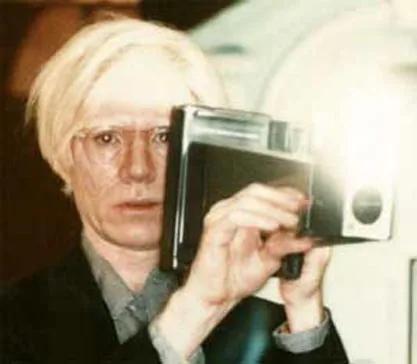
Andy Warhol with the Polaroid Big Shot
An image already held in the historical Diary archive. Museum sources now make it possible to place the camera’s role in his working method in a precise context.
In its educational resource on commissioned portraits, the museum reconstructs the sequence: Polaroid sitting, selection of the high-contrast image, enlargement, transfer to silkscreen, painted background and final photographic printing. This matters because it shows that the instant photograph was not always the finished work, yet already contained the fundamental decision about the face.
Photography, celebrity and identity
Warhol’s photographic practice extended far beyond the Big Shot. Stanford’s Cantor Arts Center built Contact Warhol: Photography Without End around more than 130,000 photographic exposures acquired from The Andy Warhol Foundation, tracing movement from contact sheets to individual photographs and serial paintings. Photography was a continuous way of encountering the social world, not a side activity.
The Screen Tests preserved and studied by MoMA also illuminate this insistence on portraiture. Famous and lesser-known faces remain almost still before the camera while light, duration and gaze construct a presence. Polaroid and film are not the same, but they share a question: how much can an apparently simple device reveal when the sitter no longer has a character to hide behind?
Why Polaroid matters in fashion photography
Before digital capture, Polaroid was also a practical instrument on fashion sets. It allowed photographers to check light, reflections, styling, make-up, pose and the relationship between body and accessory before the final exposure. That provisional function created an independent aesthetic: frontal flash, compressed space, colour shifts, physical borders and imperfections make the moment of decision visible.
When the test is chosen as the finished image, fashion loses some of its polished surface. The product remains legible, but appears within an encounter: someone holds it, wears it or brings it close to the face. Instant photography does not eliminate construction; it makes construction visible.
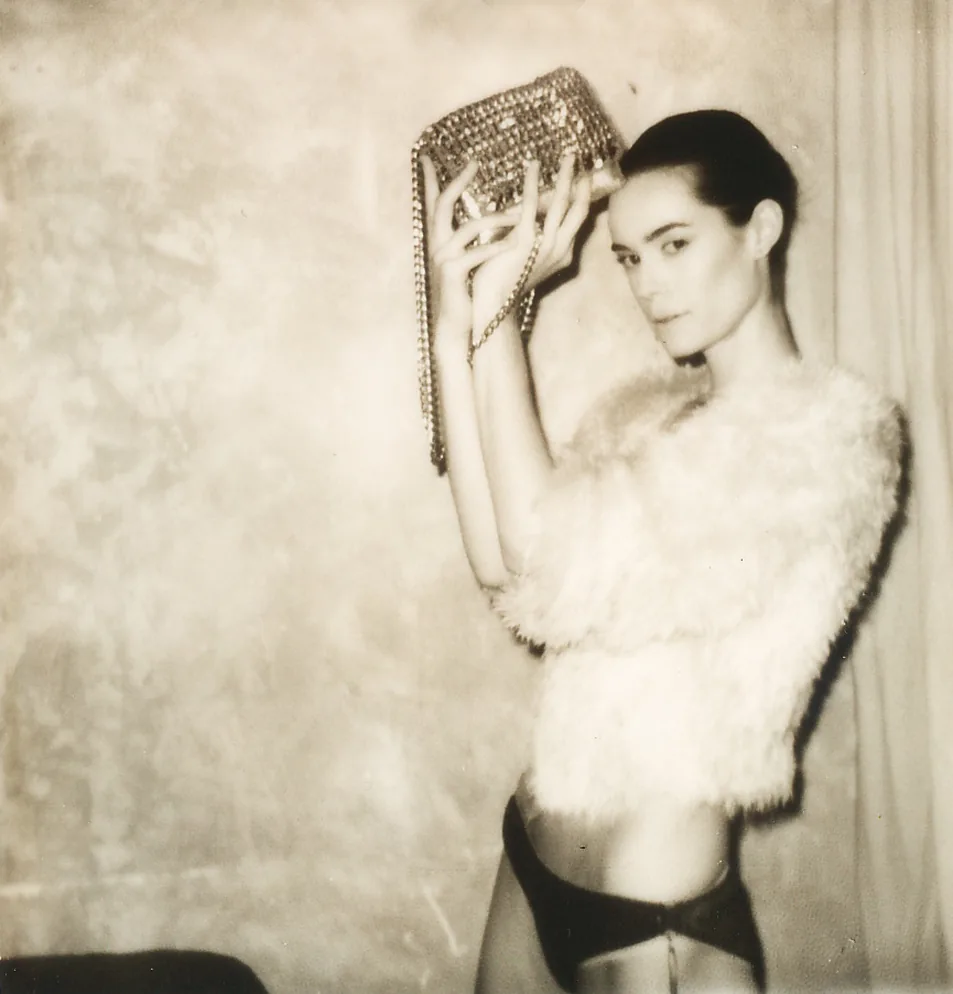
De Couture Bags · Polaroid campaign
Massimo Scognamiglio. The instant print is used as the finished image: portrait, accessory and photographic material share the same space.
De Couture: instant photography as campaign
In my photographic campaign for De Couture Bags, Polaroid is not a nostalgic filter applied afterwards. It is the language of the set. Bags are held, lifted, worn and placed before the face until accessory and portrait exchange roles. Repetition does not make the photographs uniform: shifts in exposure, temperature and gesture make each image unrepeatable.
The reference to Warhol remains historical and inspirational. His practice demonstrates how an instant photograph can be test, choice and image at once. De Couture belongs to another time, pursues another purpose and sits within my research into fashion as a construction of identity. The point of contact is a question of method: what remains of control when the result appears immediately and cannot be perfectly replicated?
Is Polaroid still contemporary?
Yes, when it is not reduced to a vintage effect. Its contemporary force lies in the relationship between constraint and decision: a few moments, a physical material, an image that cannot be corrected indefinitely. In a visual culture dominated by reversible files and invisible retouching, the instant photograph preserves the trace of what happened in front of the camera.
The bilingual De Couture Bags · Polaroid fashion photography page presents the complete sequence with search-optimised texts and image descriptions. For further stories on the relationship between body, portraiture and fashion, explore Photography, fashion and identity.