We see them every day and almost never really look at them: a yellow thermal backpack, headphones, the phone counting minutes, a bicycle carried up the stairs. The rider delivers, disappears and starts again. Riders on the Storm grows from this invisibility and turns it into a narrative question: what would happen if those who cross the city unseen decided to use that condition as a weapon?
The novel is my new urban noir. It is not a report on Rome’s Bengali community and it does not claim to speak for it. It is fiction, observing mobility, work, fear and the desire to belong through invented characters.
A crew, a city, one kilo
Ibrahim delivers pizzas and drugs. After pepper spray and a tip-off, he has seventeen minutes to carry a kilo of cocaine belonging to the Dragona family from Pigneto to Trastevere. Around him moves an unstable crew: Rash is the navigator, Ferro the dishwasher who becomes muscle, and Nab is sixteen, desperate to look like a criminal.
Apa, Samira Begum, runs Dhaka Mini Market in Torre Angela. She keeps the accounts of money transfers, debts, names and family ties. From her counter she sees an eastern Rome that many Italians leave outside the frame: Torpignattara, Centocelle, Torre Maura, Torre Spaccata, Ponte di Nona, Via Casilina after dark.
Why Apa tells the story
I chose Apa as the narrator because she does not need to explain everything. She records, measures and remembers. From the shop she watches people enter and leave, recognises fear before it becomes a confession and knows that every account can also become blackmail. Her language is spare, almost cinematic; violence arrives without warning and therefore leaves a longer trace.
In the novel, the Bengali city is not an exotic backdrop. It is a network of relationships, remittances, celebrations, shops, debts and informal courts. Alongside the Magazine path on migration and borders, this story follows life after arrival: not the chronicle of a crossing, but the life that continues and builds another centre inside Rome.
The algorithm as accomplice
Nab films everything. Through @bengalboy.it he turns a robbery into a livestream, collecting comments, followers and viewers. Visibility becomes both drug and sentence: the more the crew shows itself, the more it seems to exist; the more it exists, the more traces it leaves. Meanwhile other riders, strangers to the story, pay the price of becoming a recognisable image.
This tension between body and platform also runs through my research into identity, humanity and technology. In the noir, the algorithm is not a villain: it is a neutral accomplice, able to amplify whatever is handed to it.
Eastern Rome from the inside
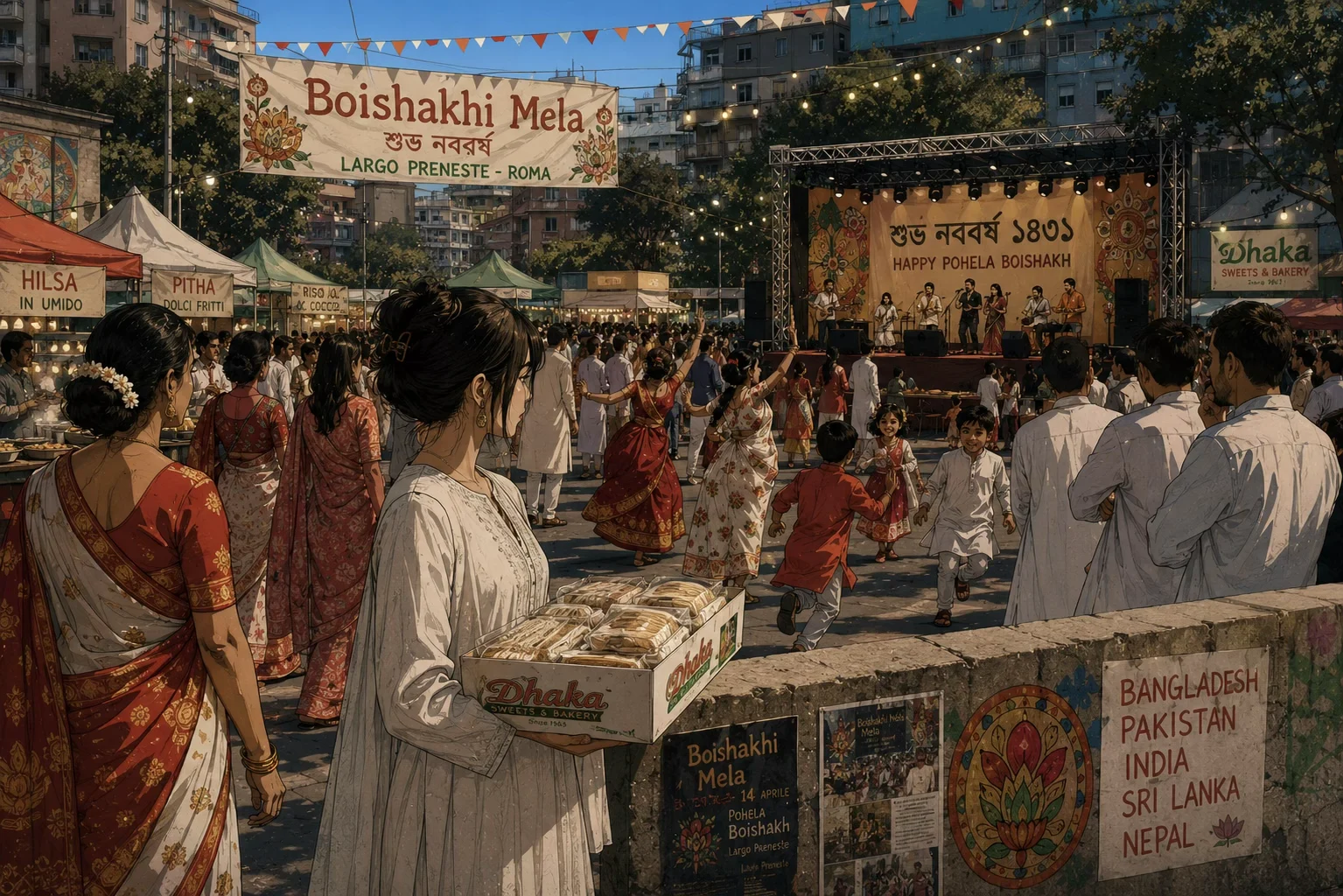
The Boishakhi Mela at Largo Preneste, the saris, food, music and signs naming Dhaka, Pakistan, India, Sri Lanka and Nepal return a plural city to view. The Bengali phrase Shohor amader. Bhoy karor na. — “The city is ours. Fear belongs to no one.” — can be a declaration of belonging or the beginning of a war. Apa knows that, sometimes, the two coincide.
Why this title
Riders on the Storm is a tribute to The Doors, but also a literal definition: the riders cross the storm and, in this story, eventually create it. The book is available as the Italian edition on Amazon and the English edition.
Artificial intelligence accompanied me as editor, translator and a documentary and philological research tool. The story, characters, Apa’s voice and narrative decisions remain mine. I disclose this because transparency is part of the work.
If you are looking for a lean, fast noir without consolation, read the complete book page or buy it directly from Amazon.


