The title stopped me before I had even seen the images: Ceuta, the suspended future of young migrants. It is a short ARTE report about the young people who remain in the Spanish enclave after the arrivals at the end of July. More than seventy thousand people left Morocco for Ceuta. Most have returned, while thousands are still there. Many are minors.
That “suspended future” is close to my own work. On 13 April 2019, in the Cinema Hall at MACRO Asilo, I presented a film shot in an occupied building in Cosenza together with photographs from Terra!. I had called the project Where is the future? Dove è il futuro?. I had no answer to offer. I had met people forced to live inside that question.
On the morning of 20 August, Spanish police cleared El Trampolín beach in Ceuta. The people who had been sleeping there were escorted to temporary shelters. Soon afterwards, the Associated Press reported, other migrants searched through what had been left behind for anything that might still be useful: a mattress, a plastic chair, a scrap of tarpaulin.
I kept thinking about those objects. Numbers describe the scale of a crisis; a mattress describes the time that follows. A person arrives, looks for somewhere to sleep and tries to hold on to the few things they have brought. When the cameras leave, that life continues.
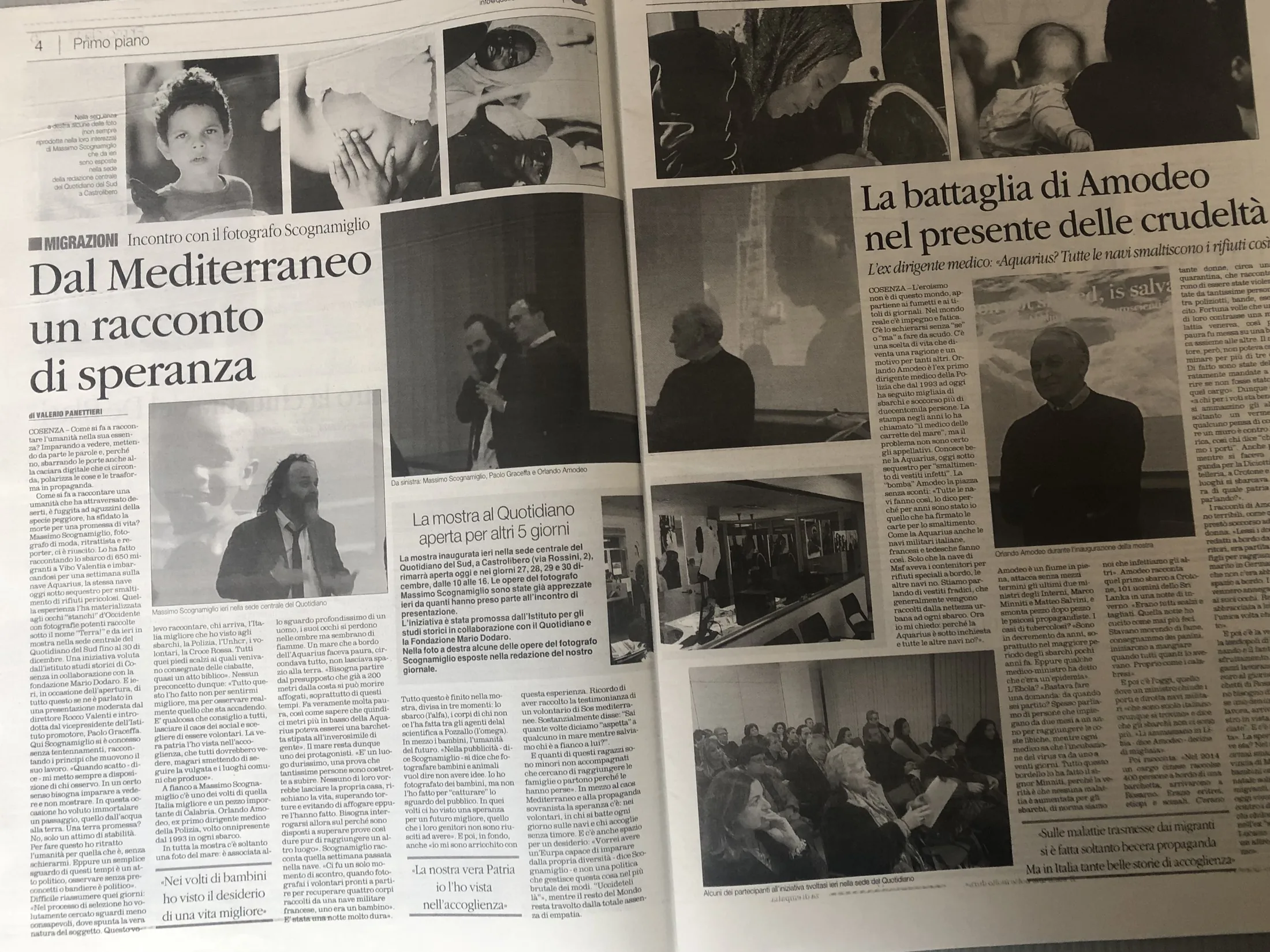
In 2017 I had photographed the landing of 650 migrants in Vibo Valentia and spent a week aboard the Aquarius. I called the exhibition Terra! because the passage that stayed with me was elemental: leaving the water and finally placing one’s feet on something solid. Not a promised land. A moment of stability.
I then entered an occupied building in Cosenza. I filmed rooms reclaimed as best they could be, families, children, household sounds and long waits. I wanted to see what happens after the journey, when the word “migrant” should give way to a person who needs to find work, send children to school, cook, sleep and imagine the following day.
In Ceuta, even the number of people who remain is uncertain. Local authorities estimate nine or ten thousand, including about two thousand minors. Spain’s Interior Ministry counts roughly five thousand. UNHCR believes that twelve hundred may be entitled to international protection. Meanwhile, a pneumatic barrier and containment buoys have been installed at Tarajal. The border has acquired a new form on the water.
The Associated Press also tells the story of Khadija Rifai, twenty years old. She swam across with her husband, then was left alone when he was sent back to Morocco. She hopes to reach mainland Spain, find him again and have a home. Amid court rulings, fences and conflicting figures, her wish is almost disarming in its normality.
Seven years after MACRO, the question is still there. Where is the future? For these young people it begins with simple, extremely difficult things: sleeping under a roof, being called by name, not disappearing from view as soon as the news moves on.