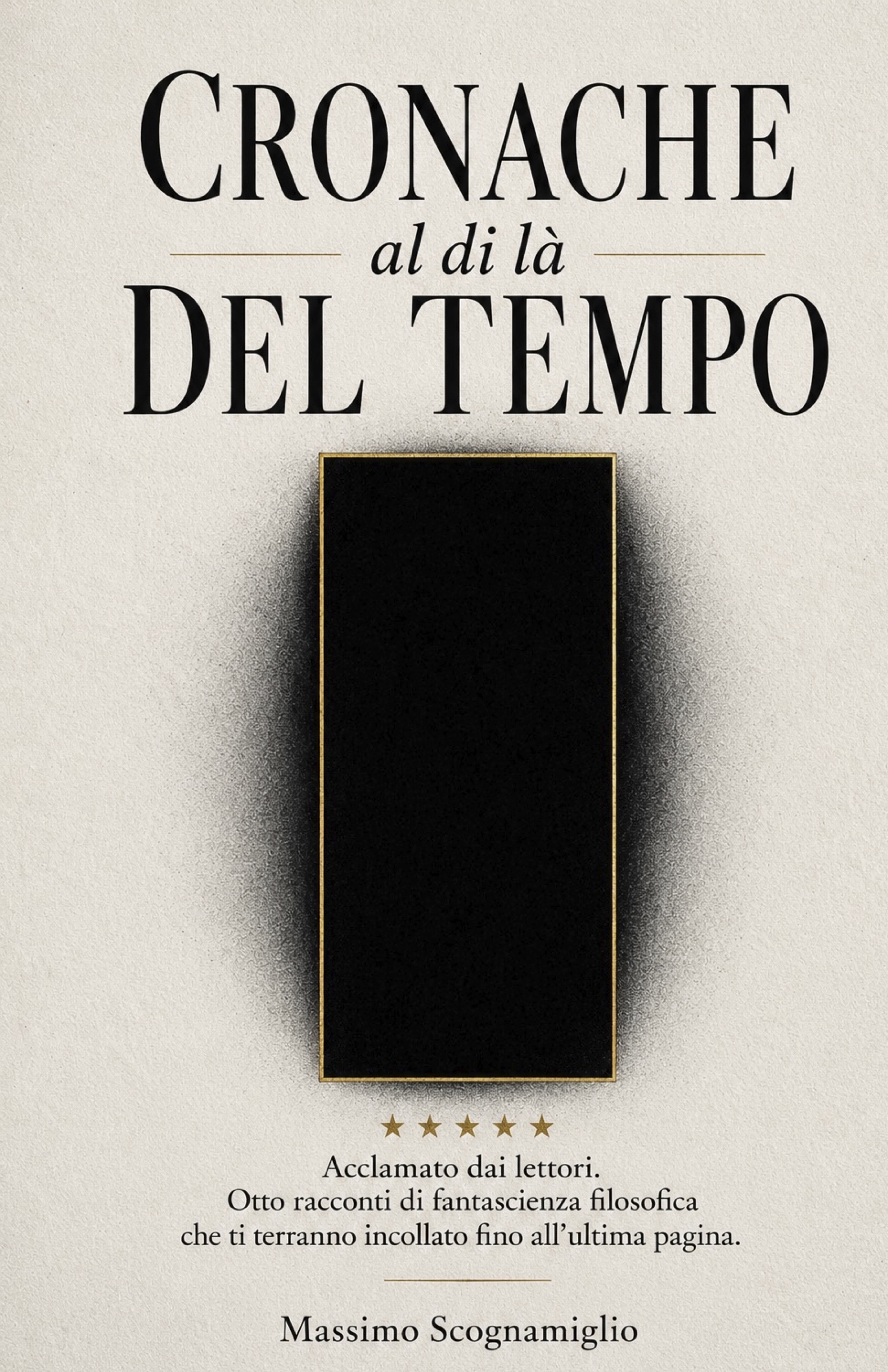
Cronache al di là del tempo brings together eight works of philosophical science fiction arranged along a reversed chronology. The near future, the Cold War, the Enlightenment, Kyivan Rus’ and a West observed from an almost inconceivable distance become different vantage points on the present. In this interview, Massimo Scognamiglio discusses the origins of the book and why every invention returns to the same question: what does it mean to be truly human?
Why tell the future by moving against time?
I wanted to deny the future the comfort of always being ahead of us. As we move backwards, the past stops being a completed place and becomes unstable territory, crossed by the same anxieties we usually assign to tomorrow. The reverse movement challenges the idea of linear progress: every era invents its own tools, but also its own forms of dependency, control and transformation.
The book’s science fiction does not live only in spacecraft or distant futures. It can appear in 1760, 1050 or Milan in 1900. What makes a past era science-fictional?
For me, science fiction is not technological furniture. It is a method: introduce an impossible possibility into a credible world and observe how that world responds. A procedure that alters memory in eighteenth-century Paris, a cubic tree in Kyivan Rus’ or a machine that makes desire visible in turn-of-the-century Milan produces the same effect as a future technology. Each shifts the boundary of what we consider human, natural or real.
What are the eight “ages” explored by the book?
Each story has its own voice and universe, yet all of them place a human being before something that alters their perception of themselves.
- The Age of Silence · 2042Ever more pervasive personal artificial intelligences gradually make speech unnecessary and turn silence into the new human condition.
- The Age of Darkness · 1986An agent named Oculopathogen Exitialis blinds humanity and plunges the world into chaos.
- The Age of Oblivion · 1760In a Franco-Chinese Paris, an experiment on memory erases the boundary between recollection and reality.
- The Age of Mother Earth · 1050An impossible cubic tree appears in Kyivan Rus’, becomes an object of worship and changes humanity’s relationship with nature.
- The Western Age · one hundred million cycles after the end of timeWhat remains of the West and of humanity is observed as the archaeological fragment of a vanished civilisation.
- The Age of Lagrange · 2001On the eve of 11 September, an anomaly involving space and the Lagrange points appears to break the known laws of the universe.
- The Age of Conjecture · 1958During the Cold War, hypotheses and suspicions grow more powerful than facts until truth itself becomes undecidable.
- The Blue Age · 1900The Ponzio Process turns fantasies and desires into visible experiences, then into an addiction and an instrument of collective manipulation.
Is technology the antagonist in these stories?
No. Technology never arrives from an innocent or evil elsewhere: it begins with a human desire and then changes those who produced it. I am interested in that passage, when a tool no longer simply performs a task and begins to suggest a behaviour, a language, a memory or even an identity. The stories deliberately leave one doubt unresolved: are we projecting the fears of the present into the past, or is the present the result of impulses that are much older?
What do the artist, the photographer and the technology professional bring to the book?
I cannot separate those experiences. Photography taught me that a frame reveals and conceals in the same gesture. Art taught me not to close meaning too quickly. Working in communication and digital culture showed me how rapidly a language can become a habit, and a habit a form of power. These perspectives coexist in my writing: I construct images, edit sequences and observe social consequences without turning a story into a demonstration.
The tone is often dark, yet the book does not seem interested in predicting the future.
I did not want to make prophecies. A prediction ages when the world takes another path; a question can continue to work inside the reader. Darkness removes protection, but it does not declare that everything will end badly. The stories do not offer a final solution because I am interested in the point at which readers must choose what to believe and, above all, recognise which part of that possibility already exists in the present.
Who is Cronache al di là del tempo written for?
For readers who look to science fiction not only for elsewhere, but for a tool with which to see their own time differently. Those who love Philip K. Dick, Stanisław Lem, Ted Chiang or Isaac Asimov will recognise the pleasure of an idea that opens a problem and continues to develop after the final page. But I also want to reach people who think they do not enjoy the genre. Here, the future is only one possible distance from which to observe the human being.
You openly disclose the use of artificial intelligence in the book. What role did it play?
Artificial intelligence accompanied me as an editor, translator and tool for documentary and philological research. It helped me check language, references, contexts and details useful to the narrative. It also contributed to early drafts of some fictional materials included in the stories — reports, minutes and supporting documents — which I subsequently reworked. I chose to disclose this because transparency is part of the work. AI was a tool in the process; the direction, imagination and responsibility for the text remain mine.
What question would you like readers to carry with them?
Not whether machines will become human, but what we will be willing to change about ourselves in order to live with what we have created. The book passes through bodies, memories, languages, fears and desires to return to that point: what does it mean to be truly human when every certainty can be rewritten?