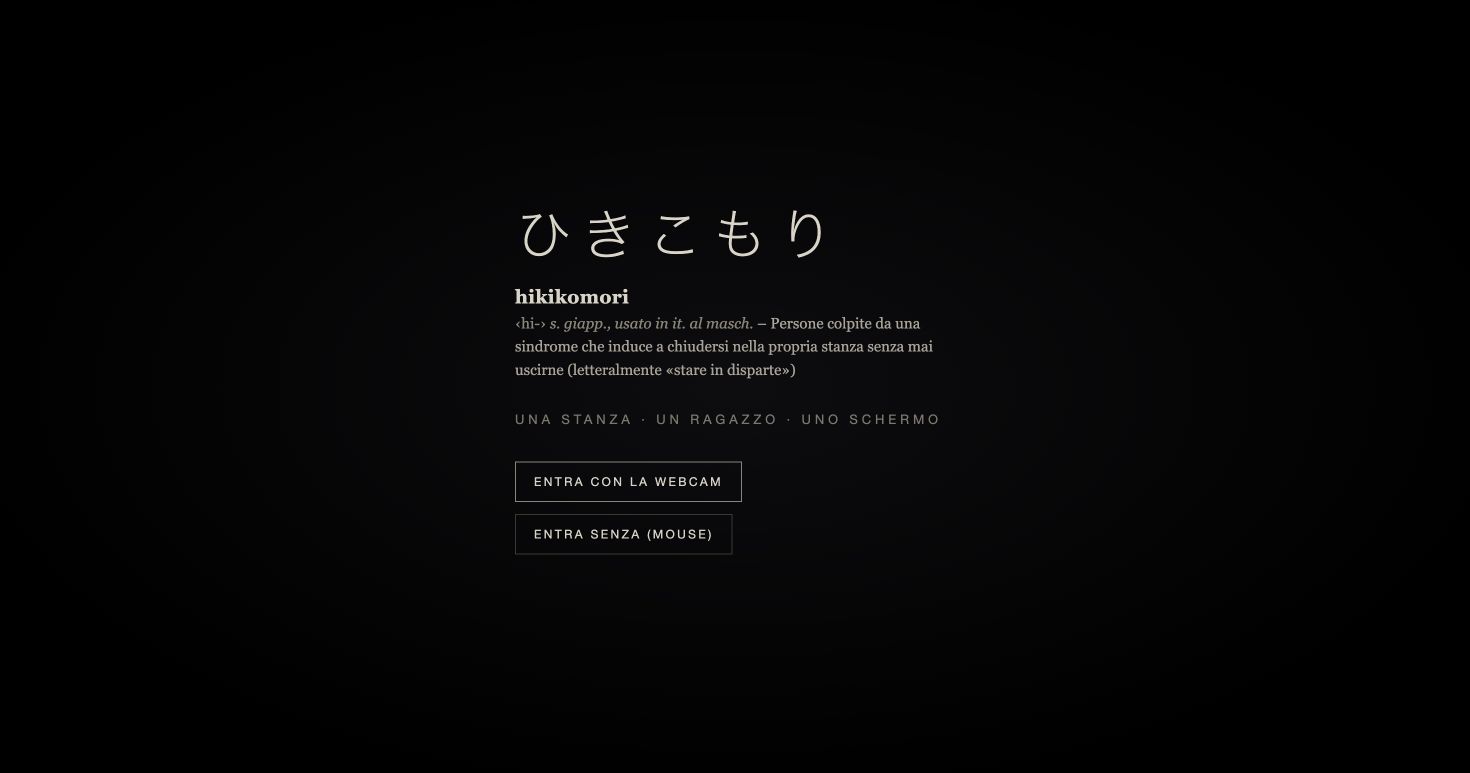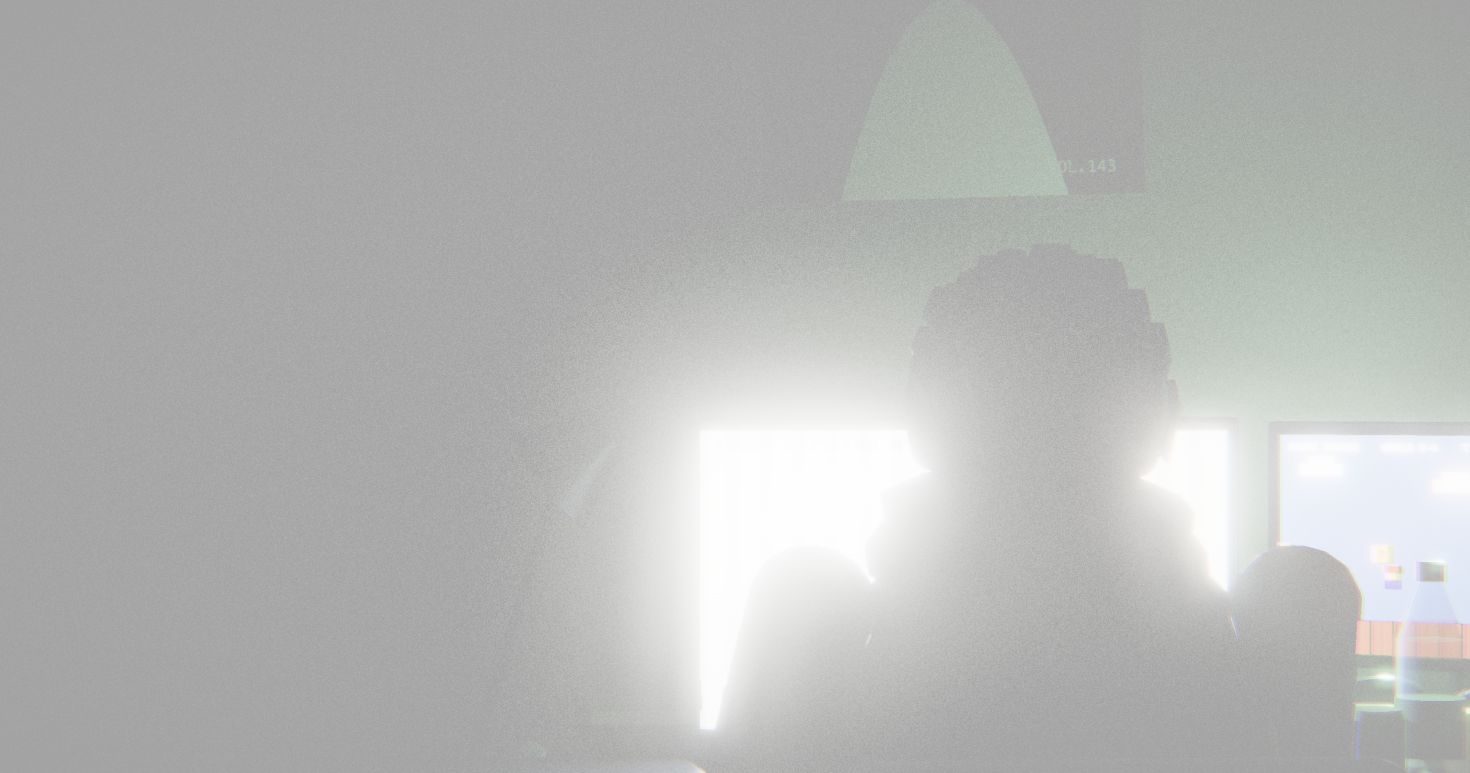
One room. One boy. One screen. Hikikomori begins with this minimal formula and turns it into an environment that cannot be viewed from a neutral position. Visitors may enter with a webcam or use the mouse. In either case this is not a gallery to scroll through: the spectator’s own movement searches for an opening in the dark.
The Japanese word literally evokes withdrawing or staying apart. In the artwork it is not a label placed upon a character, nor does it claim to replace a diagnosis. It becomes a spatial condition: the distance between a body and the world, between a door and what remains behind it, between the screen’s promise of connection and the silence that continues to occupy the room.
Enter the interactive artwork Hikikomori →
A constellation of sentences, not a floor plan
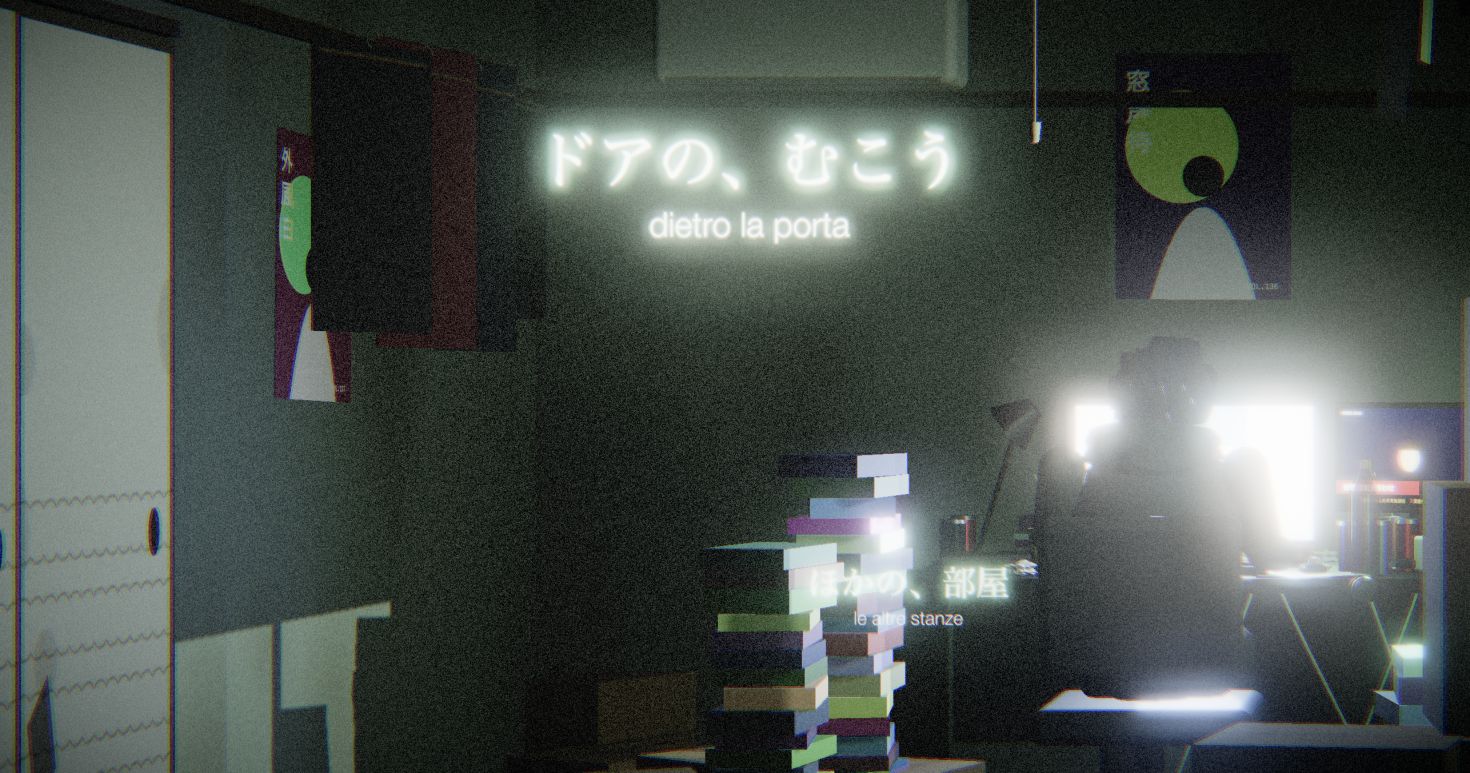
Beyond the entrance lies a black field inhabited by phrases in Japanese and Italian: only the television speaks, no one comes, only the sound of rain, snow erases sound, beyond the door, summer is outside. They are not titles arranged in a menu. They float like thoughts that have lost their sequence, luminous points in a mental geography.
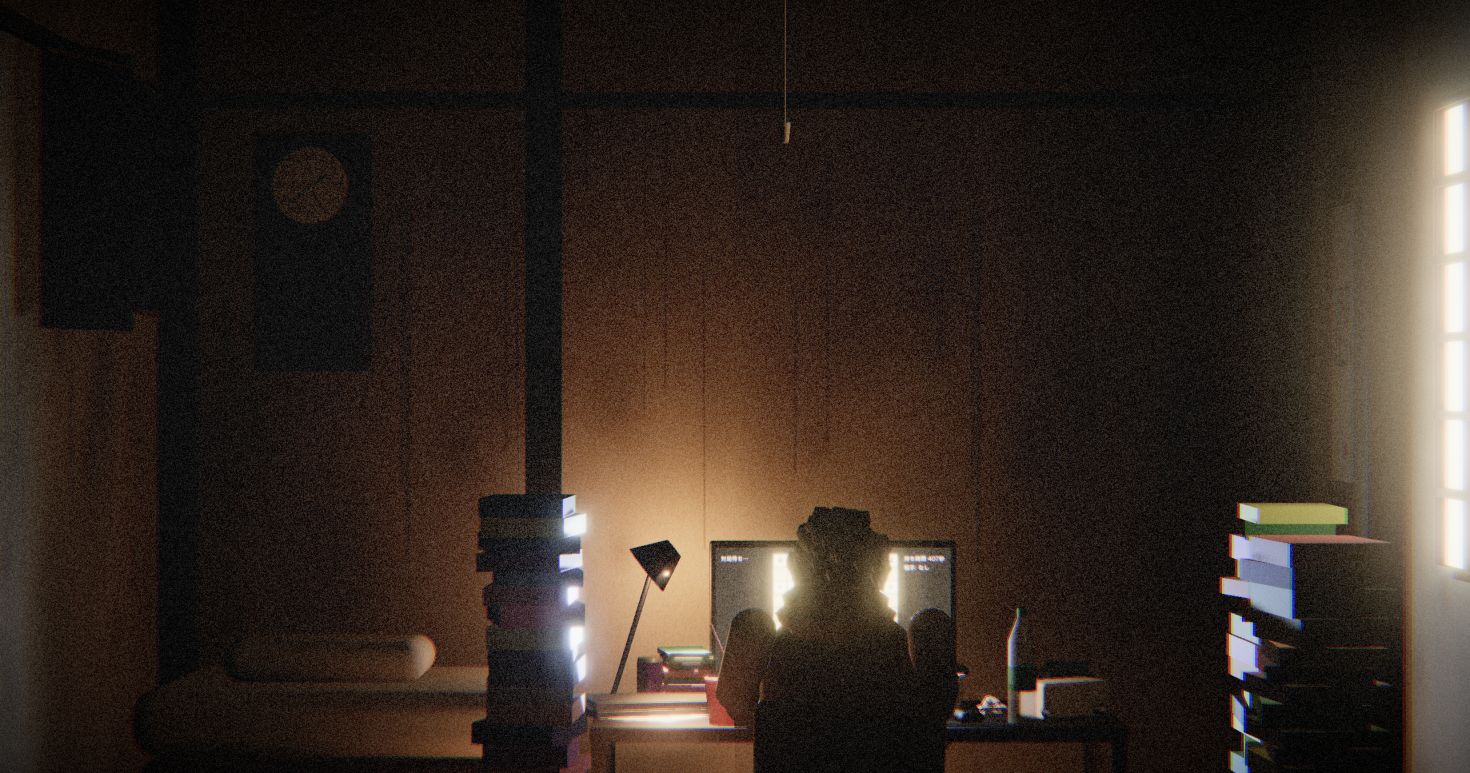
Choosing a phrase does not lead outside. It takes us further in. Every threshold opens a variation on the same condition: the temperature of light, the order of objects, sound and weather beyond the window all change. The boy, the chair, the screen and the measure of a time that advances without producing a true passage remain.
The spectator enters; the boy stays
Interactivity introduces the work’s decisive contradiction. Visitors can move the viewpoint, approach, choose a room and pass to the next. The boy stays. Our movement makes his stillness more visible. Technology usually promises control and freedom of access; here it constructs a form of powerlessness. We can see more, but we cannot rescue, question or pull the figure outside.
For this reason Hikikomori is not a narrative video game. There is no score, mission or solution. The principal action is looking, and looking becomes problematic. To enter someone’s room is to approach their solitude, but also to risk turning it into spectacle. The artwork holds the visitor on this ethical threshold: witness or intruder, presence or another screen?
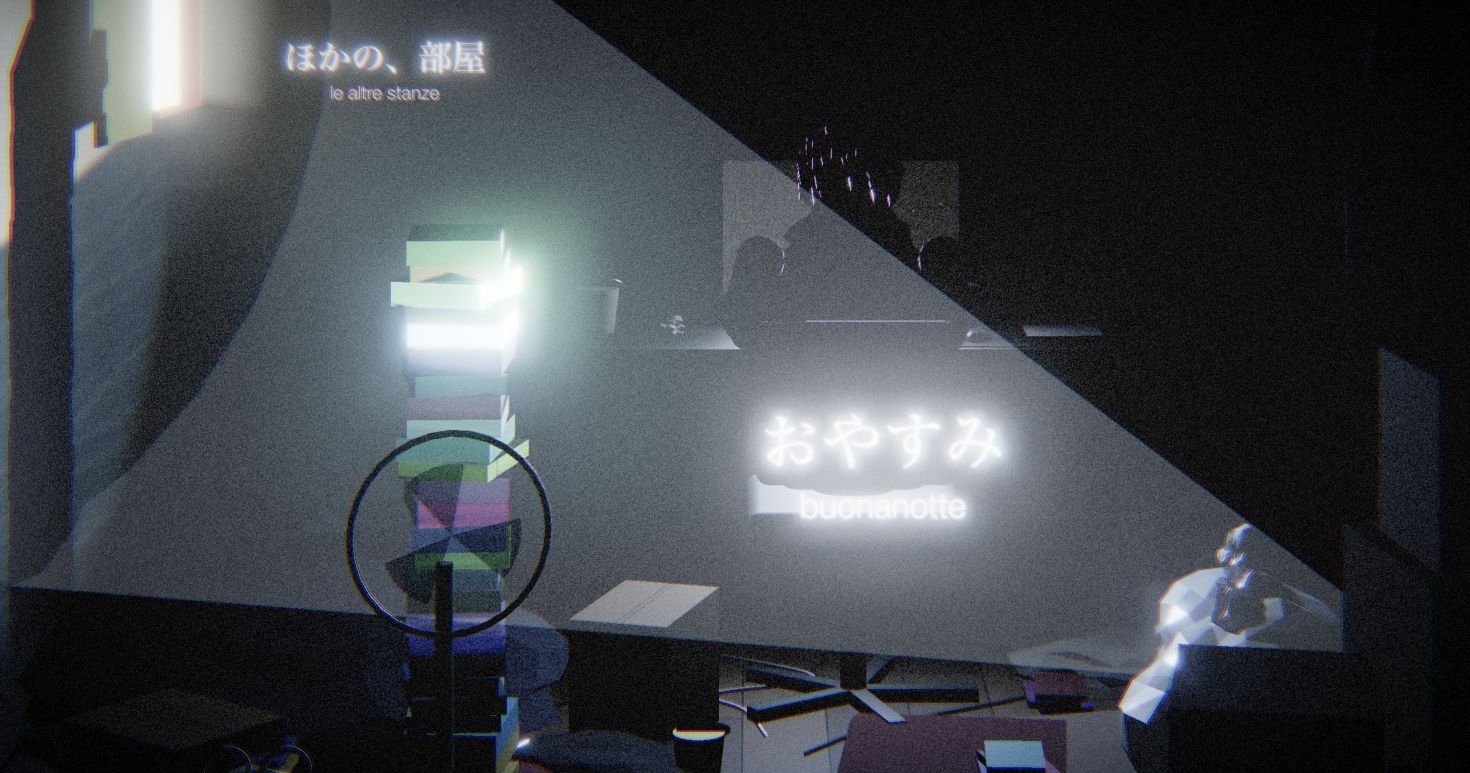
The room does not describe a home
The room has long been a central form in my practice. In the Cycle of Rooms, walls, chairs, doors and bodies do not construct believable domestic interiors; they become psychological pressures. In my reflection on The Gold Standard, I wrote that the room does not describe a home but a mental condition. Here that sentence acquires a new consequence: the room is no longer only painted. It is a traversable space that responds to the viewer’s presence.
The passage from painting to a digital environment does not erase the continuity of the practice. In the painting, the body changes the space containing it; in Hikikomori, spectators change the perspective while the represented body remains almost absorbed by the architecture and the light of the screen. The figure does not occupy the room: it seems held by it.
This continuity also runs through my reflection on the body as a field of tension and through my work on art, mental distress and the responsibility of looking. Yet the artwork refuses consolation. It does not turn suffering into a beautiful room and does not assign art the naïve task of curing.
Twenty-four rooms, twenty-four forms of enclosed time
There are twenty-four rooms. Each has its own light and sound texture: rain, wind, television, radio, a distant train, a clock, the dying buzz of neon, a voice behind the door. The environment changes, but time remains circular. Another morning arrives. Another year passes. Summer continues outside. The world produces seasons and noises; inside, every variation may be only another way of staying.
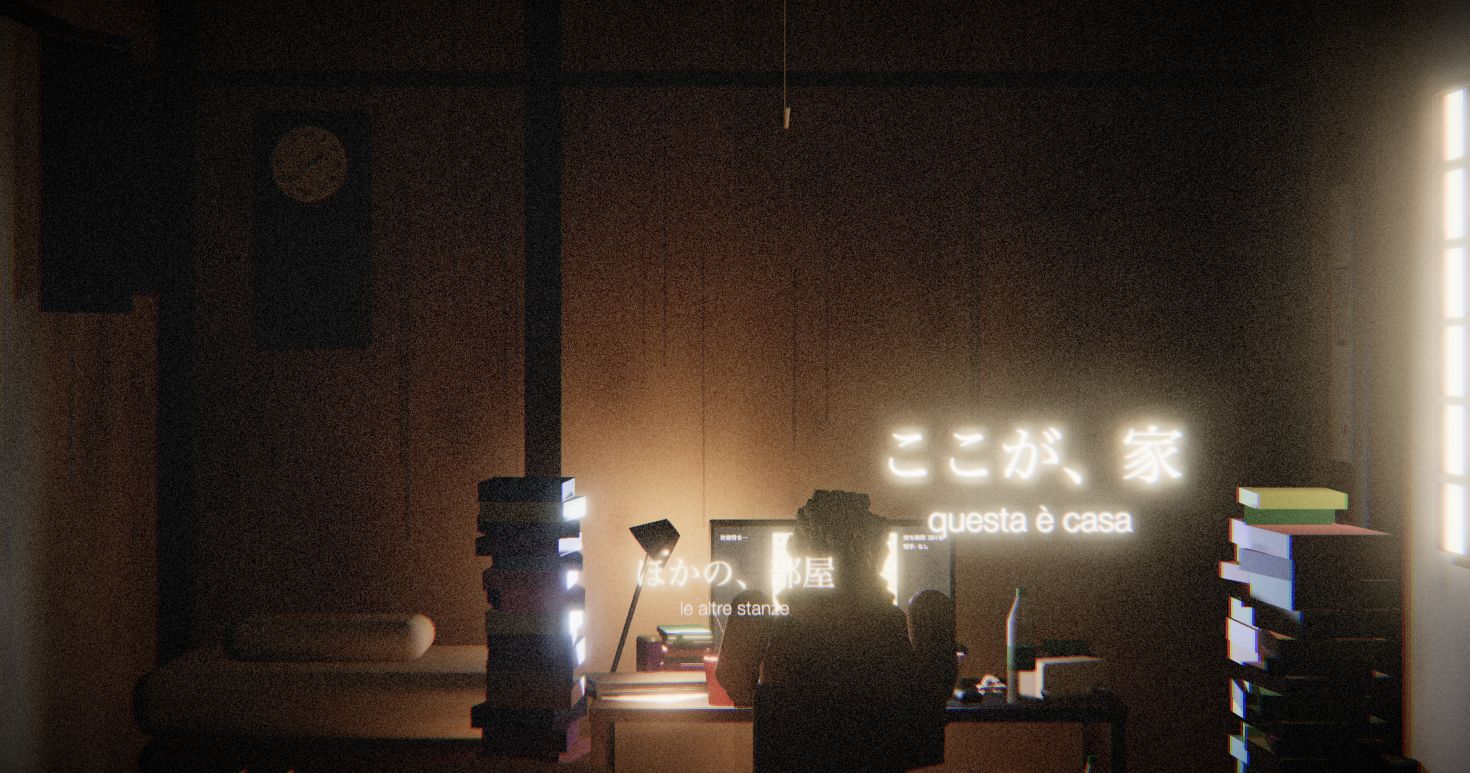
Sound matters because it makes perceptible what the image does not show. Someone coughs beyond the wall; a train passes outside; a broadcast continues to speak. Solitude is not absolute silence but other lives heard without being joined. Even when networks and screens remain on twenty-four hours a day, connection does not become contact.
A self-portrait without a face
The boy often appears from behind, facing one or more monitors. He offers no face to interpret and does not solicit empathy through expression. He is instead a human measure inside a device that continues to produce images. In this sense Hikikomori enters into dialogue with my films made with artificial intelligence: here too, technology is not the celebrated subject but the place where desire, fear and memory become visible.
The work is completed only in the duration of a visit. Each spectator constructs a different sequence, yet no sequence leads to a definitive release. One may return to the constellation of sentences, choose another light and listen to another noise. The room changes. The question remains: how much distance can survive inside continuous connection?
Artwork and images
Hikikomori, 2026 · online interactive digital artwork, 3D environment, sound and navigation by webcam or mouse · conceived and created © Massimo Scognamiglio. These images document different passages through the experience and do not grant a reuse licence. For editorial or curatorial enquiries, contact the studio.