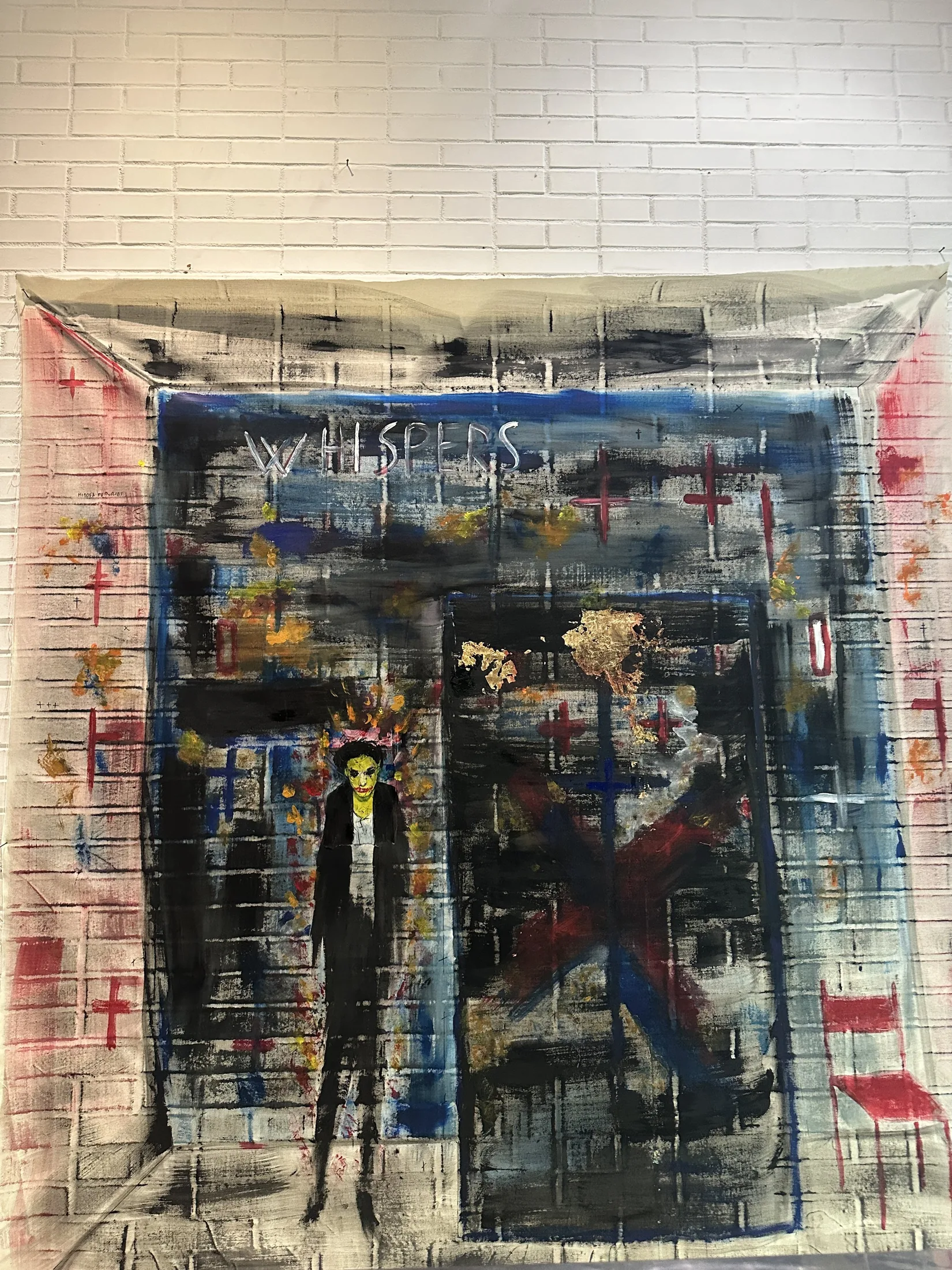
In brief: a painted body is never merely the description of an anatomy. The way paint compresses, blurs, tears or reconstructs the figure also makes time, memory and spatial pressure visible. Jenny Saville’s Venice exhibition offers an occasion to return to this question; in my Cycle of Rooms, the question takes form through an autonomous language and history.
Jenny Saville at Ca’ Pesaro: flesh as the language of painting
From 28 March to 22 November 2026, the International Gallery of Modern Art at Ca’ Pesaro is presenting Jenny Saville’s first major exhibition in Venice. More than thirty paintings and drawings trace her work from the 1990s to the present; the final room contains a previously unseen cycle made in homage to Venice. The museum foregrounds the dialogue between Saville’s monumental canvases, figurative painting and the Venetian tradition.
In a direct conversation with Stefania Ventra, Saville discusses Titian through emotional depth, the construction of flesh and compositional rhythm. The observation is crucial: the body does not precede painting as an object to be copied. It emerges from colour, layers, revisions and the movement of the mark. Deformation does not necessarily destroy the figure; it can make its inner life perceptible. For me, Saville is a master of contemporary painting and a source of inspiration precisely because of the freedom with which she keeps this question open.
Francis Bacon: the body inside a psychological structure
Among the masters who shaped my way of seeing, Francis Bacon takes this tension in another direction. The Estate of Francis Bacon’s catalogue raisonné describes how the linear structures of his 1960s paintings developed into increasingly abstract interiors during the following decade. The figure remains, but space contracts into a cage, a platform or the trace of a room. It is not a neutral background; it is psychological pressure.
This thread also continues in my earlier essay on Francis Bacon and contemporary portraiture. Saville and Bacon are masters and sources of inspiration, not terms of comparison with my work. Their work helps me formulate questions about the figure; the Cycle of Rooms moves through those questions as a personal inquiry, born in another time and from another biography.
In the Cycle of Rooms, the body changes its environment
In the Cycle of Rooms, walls, chairs, beds and openings refuse the logic of domestic perspective. Space is compressed, tilted or emptied until it takes on the figure’s instability. The reclining body does not truly rest; the seated body is not safe. Both turn the room into an indirect self-portrait.
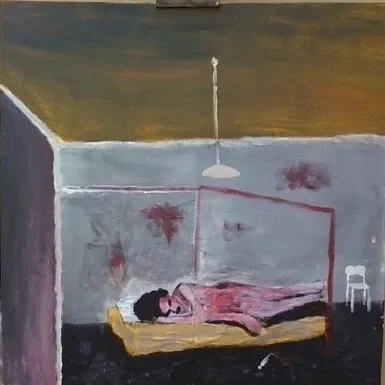
Reclining figure · Cycle of Rooms
Massimo Scognamiglio · Mixed media on canvas. Bed, wall and body become a single emotional architecture.
In the reclining figure, painterly matter does not simply cover the canvas: it builds a threshold between vulnerability and resistance. The small white chair, the bed and the lamp measure the room, but the body’s position determines its weight.
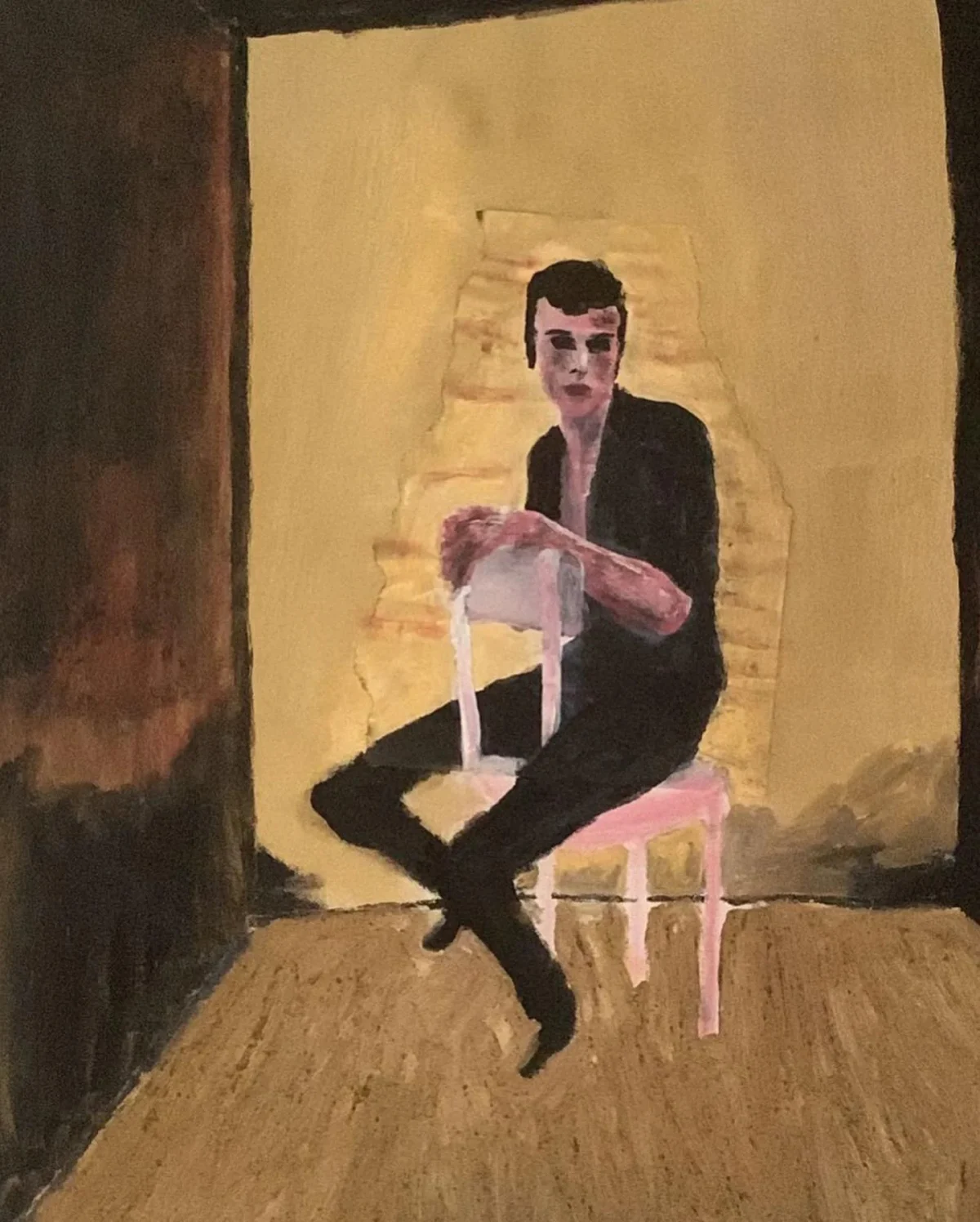
The Seated Man · Cycle of Rooms
Massimo Scognamiglio · Mixed media on canvas · Private collection. The figure crosses through the chair and the space instead of allowing them to contain him.
The Seated Man, now in a private collection, makes this collision even clearer. The legs cut through the foreground, the pink chair loses its ordinary function and the ochre room becomes a mental surface. The painting does not illustrate a body: it shows the unstable relationship between presence and containment.
From Roma Arte in Nuvola to a private collection
The presentation of the work with Supermartek at the latest edition of Roma Arte in Nuvola 2025 attracted strong attention from visitors and collectors. The fair’s official list confirms Supermartek among the exhibitors. For the Cycle of Rooms, that response matters because it connects research begun in 2008 with its reception today: not an isolated episode, but a project that continues to generate works, conversations and acquisitions.
Art under €5,000 and Italian mid-career artists to invest in
Anyone searching for art under €5,000, artists to invest in or Italian mid-career artists to invest in needs verifiable signals rather than slogans. In my case, these include continuous exhibition activity since the mid-1990s, museum experience, works in public and private collections, two Exibart Prize finalist selections and inclusion in Exibart’s 222 Emerging Artists to Invest In 2026.
The Invest in Art page organises this evidence as a collector Q&A, while the selection of contemporary artworks under €5,000 presents paintings and photographs whose availability must be confirmed directly. The published studio coefficient is 2, based on the documented trajectory; it is not a promise of financial return and does not replace a collector’s independent assessment.
The cultural value of a mid-career practice also lies in its legibility over time. In the Cycle of Rooms, the painted body continues to change because the room watching it continues to change. This is where matter, biography and the history of images cease to be separate categories.