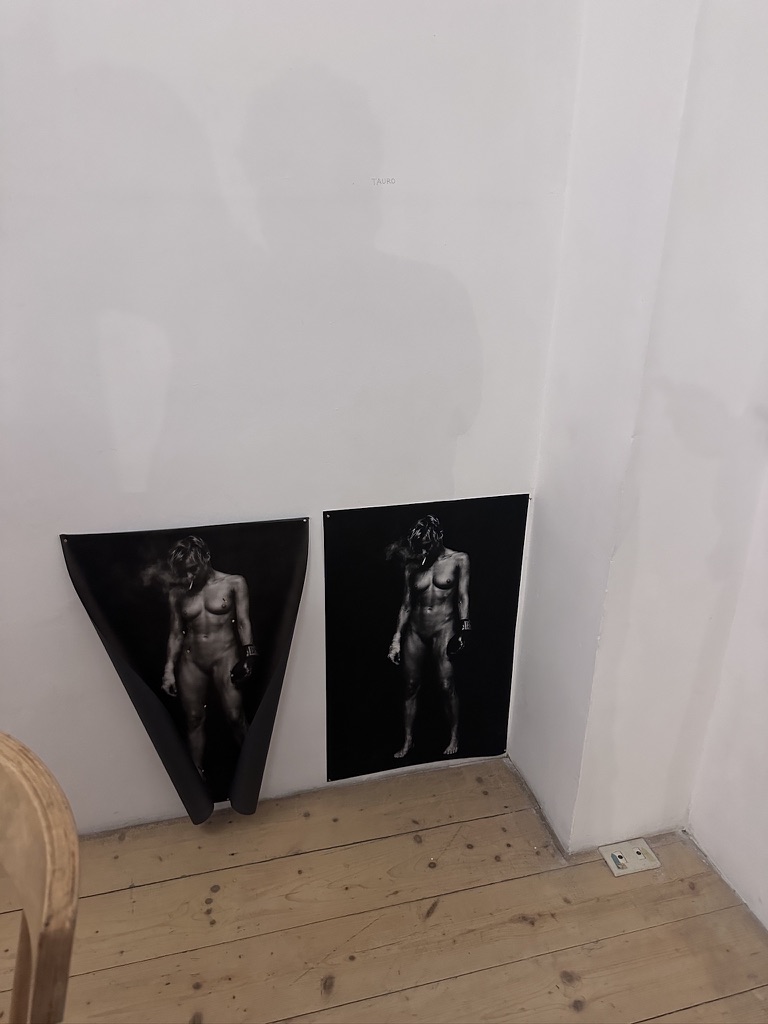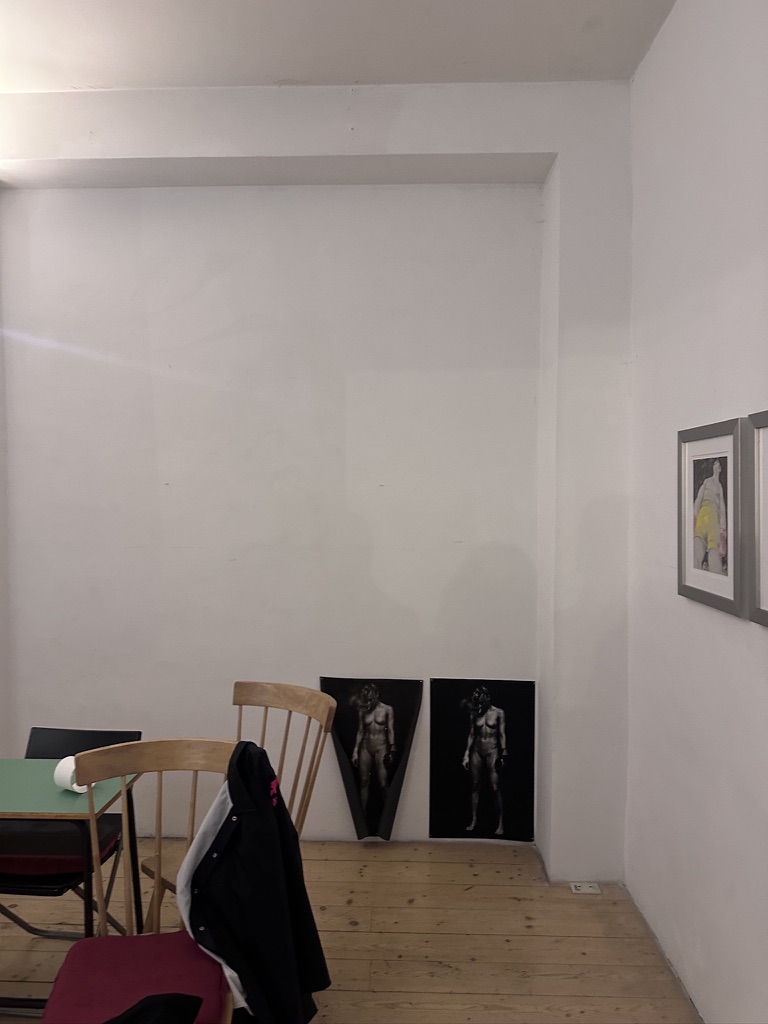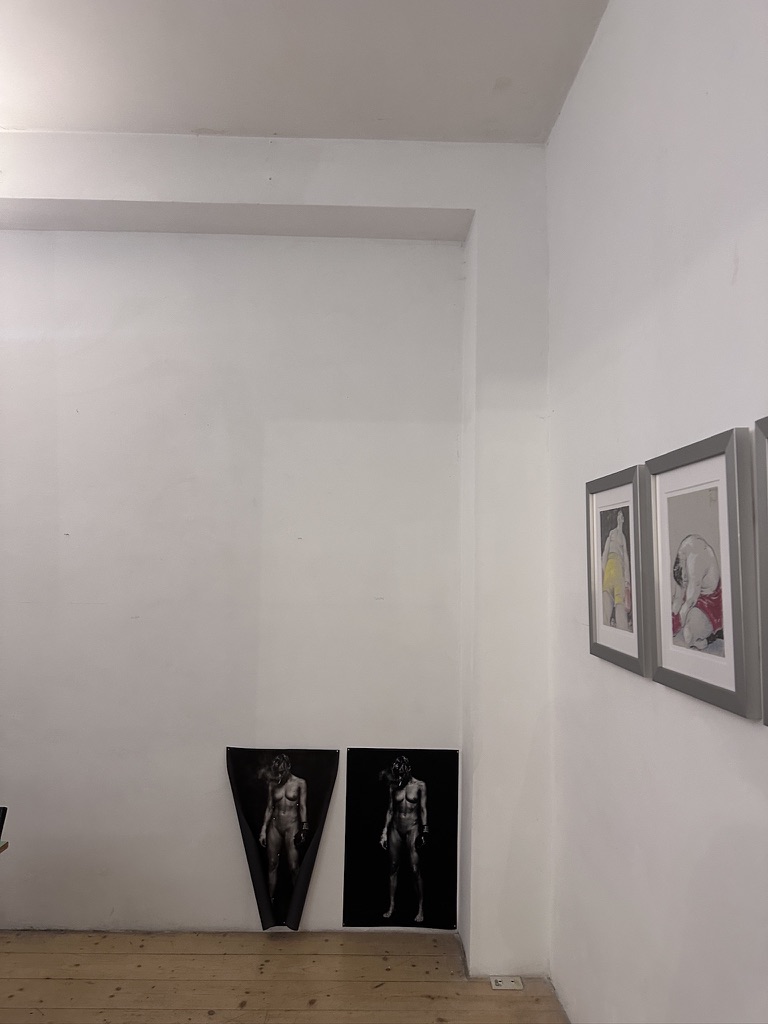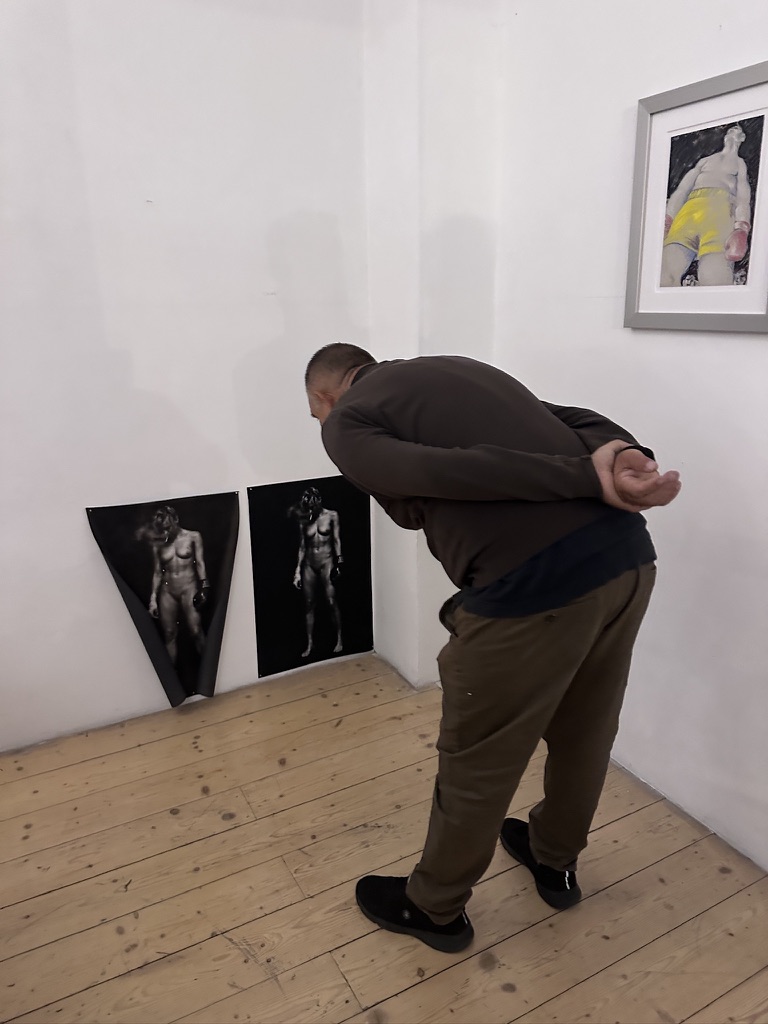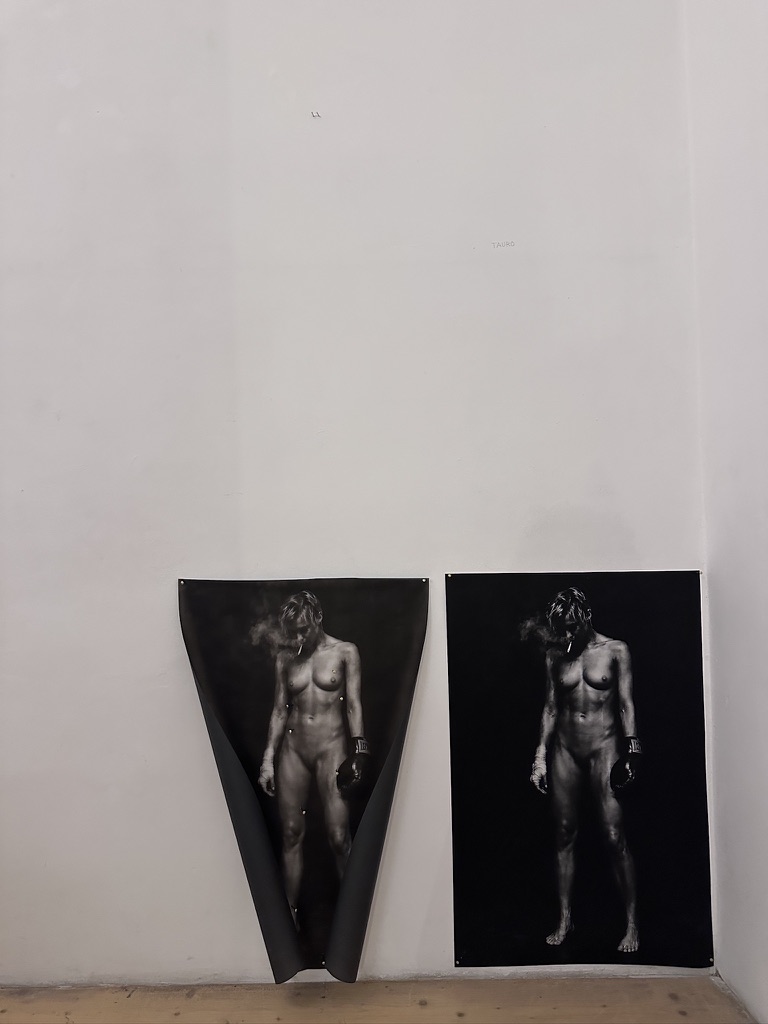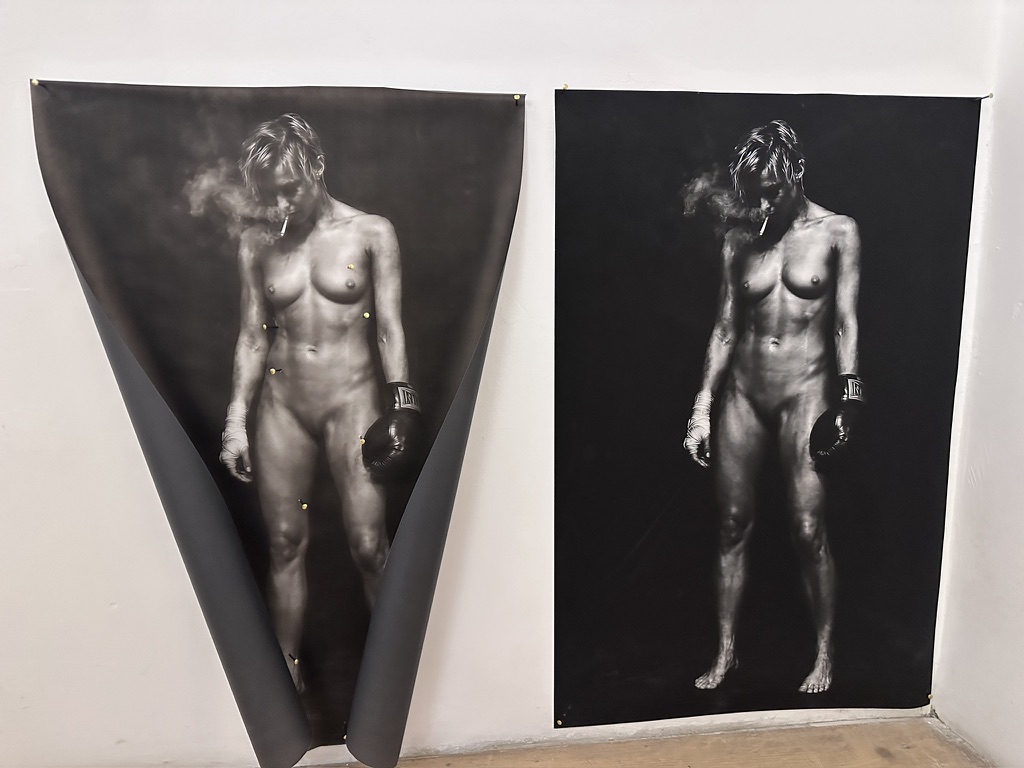
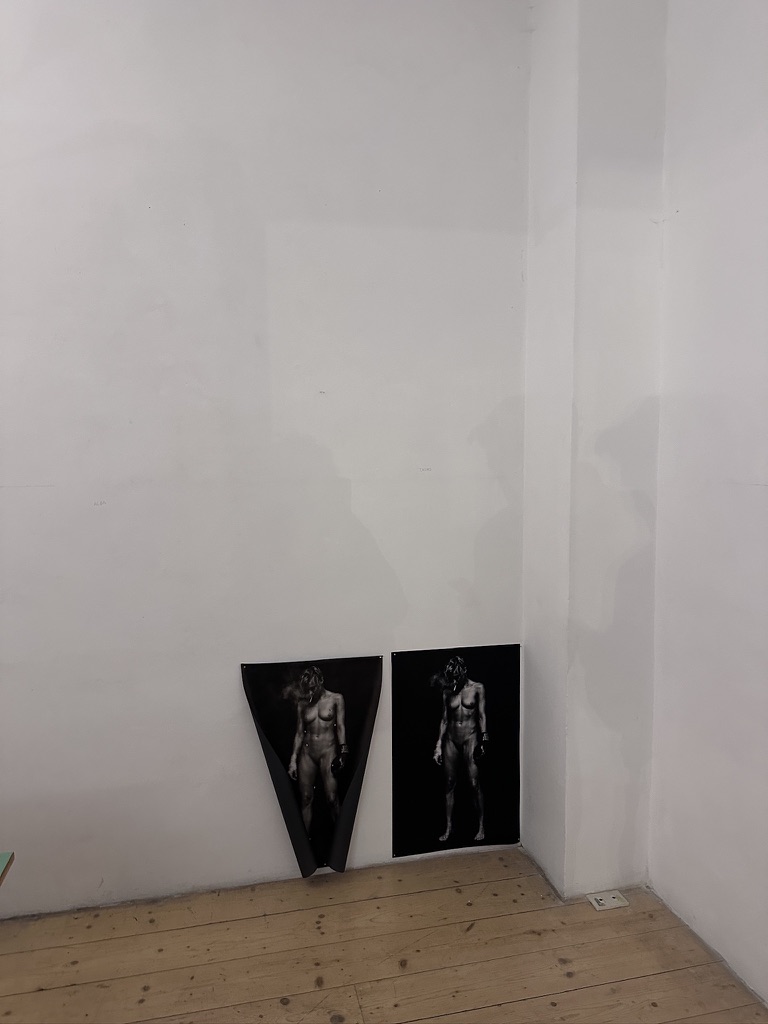
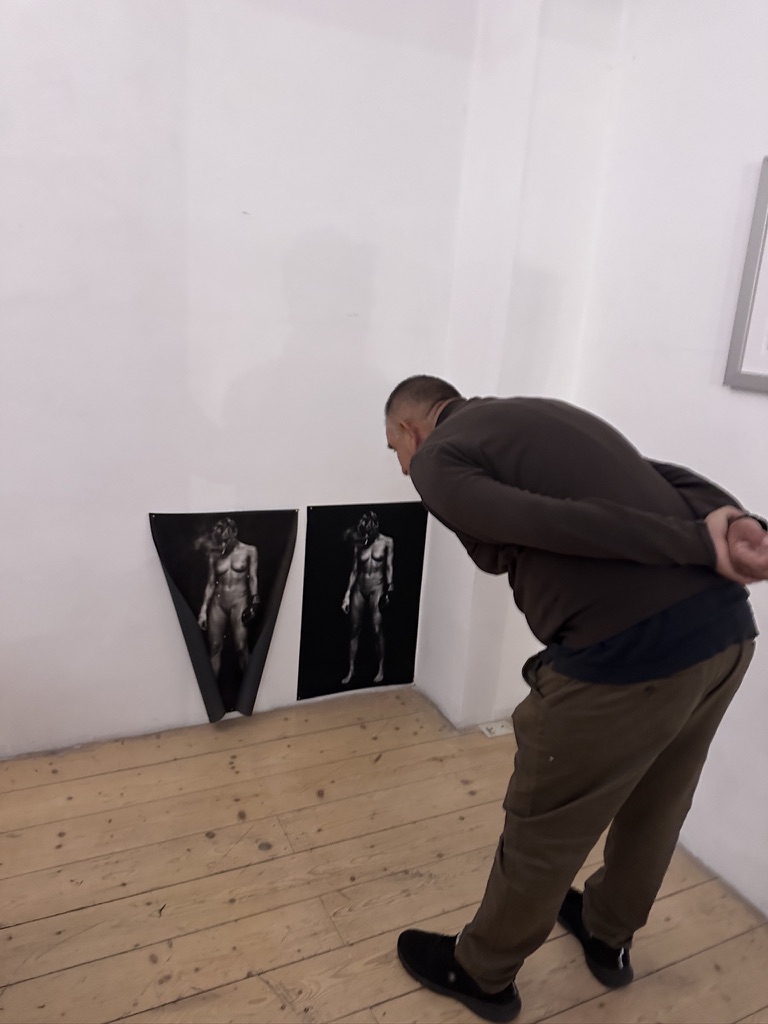
At Primo Round, I’m so tired is not hung at eye level. Two prints of the same figure are nailed to the wall almost on the floor, where two walls meet. To see the work properly, viewers have to move closer and bend down. The act of viewing changes: for a moment, the spectator loses an upright, commanding position, while their body answers the exhaustion of the body represented.
The first Magazine story about Primo Round and I’m so tired introduces the exhibition and Andrea Iezzi’s critical text. Here I want to remain with what happens in the space: not only the image, but its height, materials, nails and the posture the installation imposes on those who look.
After the fight
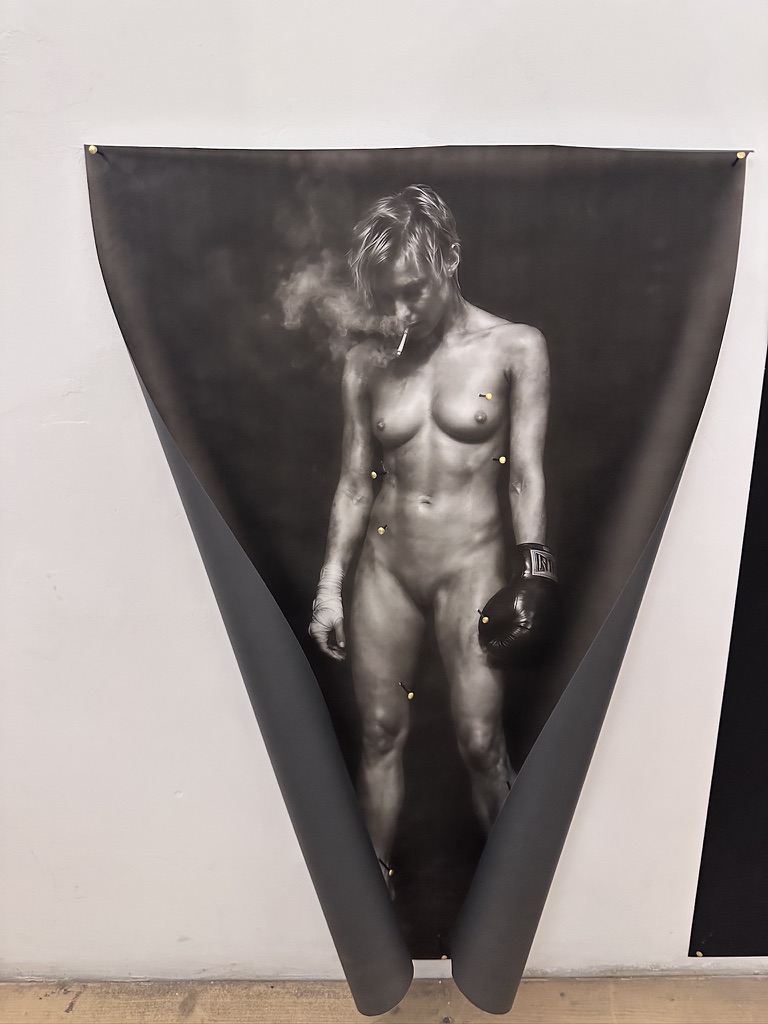
The woman is nude, muscular and statuesque, yet her strength does not coincide with a victorious pose. She wears a boxing glove on her left hand and wraps on her right. Her gaze is lowered and she is smoking. The smoke interrupts the action and measures a suspended time: the round has ended, or perhaps the next one has not yet begun.
The single glove creates an asymmetry. One hand is still armed; the other retains only the preparation for a blow. The body stands between fighting and disarming, resistance and surrender. The title, I’m so tired, is not a caption but an inner voice: the sentence left behind when the rhetoric of performance, discipline and victory is no longer enough.
One image, two material bodies
The work is presented as two prints. One is made on watercolour paper: it absorbs the black, holds a more muted light and curves away from the wall. The other, on glossy paper, remains tauter, colder and more compact. The first resembles skin or wounded matter; the second retains something of the photographic icon, the poster and the polished image.
The double is not there to repeat. It separates two conditions of the same figure. Watercolour paper makes the weight, fold and fragility of the support visible; the glossy surface returns a seemingly intact body. Between them opens the distance between what an image promises and what matter undergoes.
The nails and Saint Sebastian
The nails are not concealed by the installation. They pierce the paper and, at several points, coincide with the woman’s body. They physically support the work, but in the same gesture become wounds, recalling the iconography of Saint Sebastian, pierced and exposed to the gaze.
Here, however, there are no arrows and no glorification of martyrdom. There are ordinary wall nails, blunt and concrete. Pain is not only represented in the photograph: it enters the very way the photograph is fixed in place. The figure remains standing but lowers her eyes; she does not offer her face to the public or turn suffering into heroism.
The corner of the room, the corner of the ring
The low placement in a corner is not an exhibition compromise. The corner of the room becomes the corner of the ring: the place a boxer returns to between rounds, where the body is tended, breath is heard and what remains is measured. The white wall, left almost entirely empty above the work, intensifies the fall towards the floor.
To see the face, glove, wraps and nails, visitors are forced to bend. It is an involuntary bow, recorded in the installation photographs. The viewer’s body therefore enters the work: it gives up the comfortable distance of museum vision and assumes, if only for a few seconds, a posture of attention, fatigue and vulnerability.
Strength without triumph
I’m so tired does not show a winner and does not certify a defeat. It shows what comes after the continuous demand to endure. Nudity removes uniform and protection from the boxer, but does not reduce her to a passive body: her stillness remains a form of opposition. She does not look at the audience, ask for approval or stage the blow.
In this sense, the figure also overturns the traditional gender codes noted by Exibart and Oggi Roma. Strength is not made masculine and vulnerability does not become weakness. The body can be statuesque, exhausted, wounded and still present at once.
Primo Round, in space
Before the opening, Acquistare Arte asked which images would absorb the blow of the space and which would return it. In I’m so tired, the answer lies in the installation: the work absorbs the wall, the corner and the proximity of the floor, then returns that weight through the viewer’s posture.
Primo Round — The Dance of Bodies, Shadow and Light, curated by Andrea Iezzi, brings together eleven artists at Studio Campo Boario. The exhibition is part of the Rome Art Week 2026 programme and runs from 15 to 31 October 2026.
Artwork and installation photographs
I’m so tired, 2026 · double photographic print on watercolour paper and glossy paper, nails, installation. Artwork and photographs © Massimo Scognamiglio. Publication does not grant a reuse licence. For editorial enquiries or information about the work, contact the studio.