In 1998 I presented La Coscienza Luccicante at Palazzo delle Esposizioni, an artist’s CD-ROM made from pixels, interactivity and images. I did not feel that I was leaving painting behind. It seemed that I was enlarging the space in which it could happen.
More than twenty years later, Damien Hirst built The Currency around an opposing logic: not coexistence, but choice. Launched in 2021, the project paired ten thousand works on paper with ten thousand NFTs. Collectors had to decide which form to keep. Those who claimed the painting relinquished the token, which was destroyed; those who retained the NFT consigned its physical counterpart to the fire.
The exhibition at Newport Street Gallery, documented by HENI, ran from September to October 2022. During Frieze Week, Hirst personally began the burning ritual. In total, 4,851 physical works—the ones surrendered in favour of their digital versions—were gradually incinerated in the gallery.
It is easy to stop at the spectacle: a famous artist, thousands of works, fire and the cryptocurrency market. The part that interests me is quieter. Each owner was asked to make a preference irreversible. It was not enough to say that painting and token carried equivalent value. That value had to be produced by making the alternative disappear.
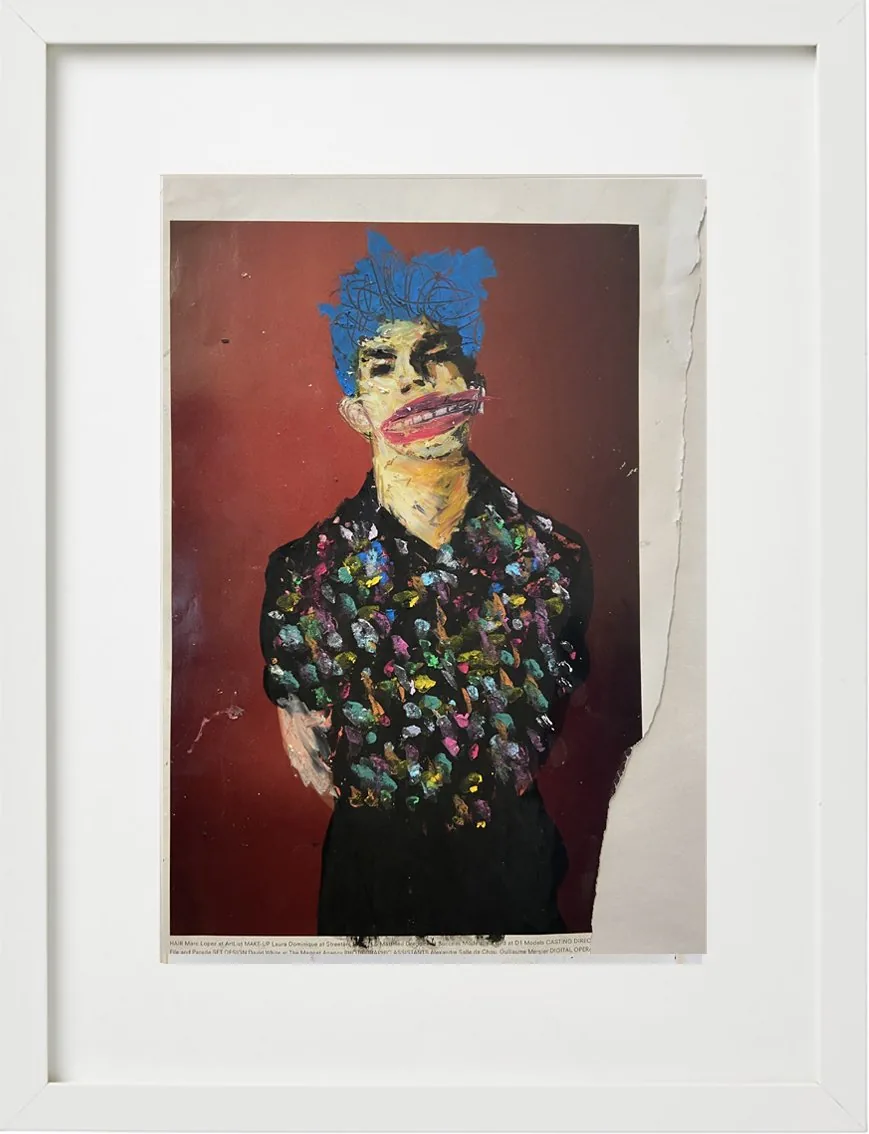
My history with digital media, also described in the site’s biography, begins from another idea. I have painted with physical materials and on touch devices; I have worked with photography, video, the web and objects. I have never needed one language to kill another in order to become authentic. Even in the Strappi, destruction is a passage rather than an endpoint: the torn image is reassembled and begins to produce meaning again.
The Currency remains an exceptionally precise conceptual machine. It combines trust, scarcity, property and desire, then gives the final decision to the collector. The fire does not merely erase coloured paper; it makes the price of certainty visible. To believe that they truly possessed one thing, those owners had to accept that they could no longer possess the other.
This is where the project ceases to be only about NFTs. Every digital identity promises to multiply us, and every archive appears capable of preserving everything. Then a choice arrives and we discover that value is still often born from what cannot be recovered.