d la Repubblica has chosen the right question for punk’s fiftieth anniversary: what remains? This is not an easy anniversary. Punk was born to burn quickly, not to become a date on the cultural calendar.
There are several possible beginnings. The article returns to London in the summer of 1976, to the Ramones at the Roundhouse on 4 July, to the Sex Pistols and Anarchy in the U.K. The rupture matters more than an exact day. The music was short, physical and stripped of ornament, aimed at a rock culture that had become wealthy, technical and remote. But sound was only part of it. Punk entered graphic design, clothing, photography, cinema and the way a body could occupy public space.
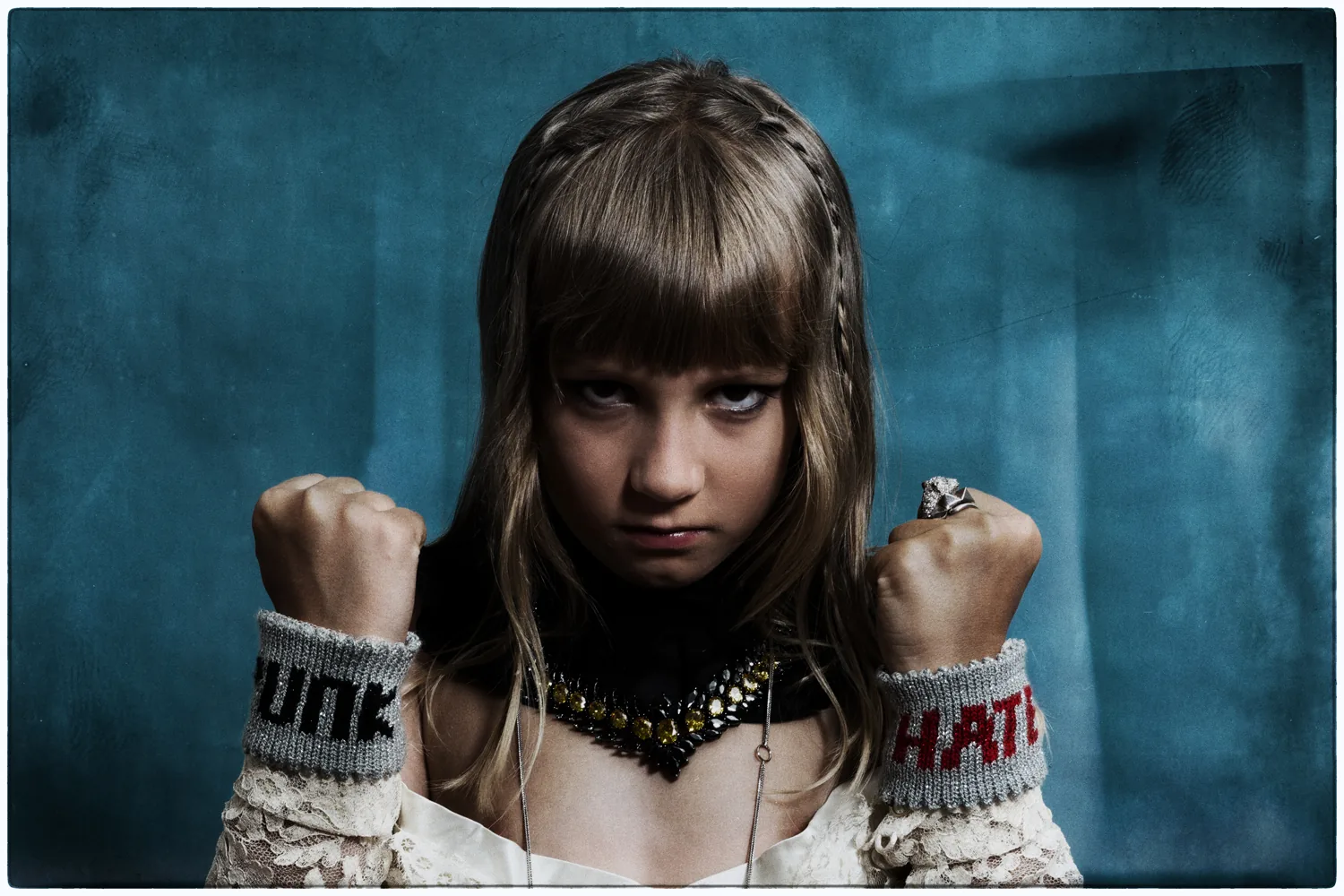
When I made Punk Aristocracy in 2016, I began with what had happened afterwards. Rebellion had been absorbed. Chains, studs, torn fabric, hair and poses had travelled from the street to the catwalk, from threat to advertising, until they became luxury goods.
The exhibition at Takeaway Gallery brought together thirty photographs in black and white and colour, plus one image printed in an edition of ninety-nine. There were children who looked almost adult and adults who remained children, historical punk beside goths and ravers, then the softened versions produced by fashion and television. I was not trying to reconstruct a music scene. I wanted to observe the moment when a sign created to reject the system is welcomed by that system and placed back on sale.
I told la Repubblica Roma that punk had entered everywhere and had been violated at the same time. I imagined an intruder walking into an aristocrat’s house to throw a party. Once the intruder falls asleep, the prince steals whatever he can use.
Ten years later, the question remains open. Today a gesture can be photographed, shared, copied and sold almost as soon as it appears. The distance between dissent and trend has become very short. Yet some images retain a splinter that cannot be polished away. That is what I was looking for in the faces and bodies of Punk Aristocracy.
In 2026 punk turns fifty and Punk Aristocracy turns ten. A new tenth-anniversary edition of the project will soon be shown in Cosenza. I will say no more for now. Stay tuned.
This will not be an exercise in nostalgia. I want to place those photographs in front of the present and ask whether the wound is still open, or whether even the memory of rebellion has become an elegant surface. If punk has survived anywhere, perhaps it is in the discomfort that this question can still produce.